Zone - James Tunks
Our philosophical understanding of the photograph may find its bearings in notions of time and the past, but our tools for making images are imbedded in the aggressive stride of technological innovation and forward thinking. Cameras now possess the ability to sense, capture, process, describe, augment, predict, and ‘think’, in increasingly pervasive ways. And like most computational devices, the camera is not immune to the disruptive forces of AI and machine learning.
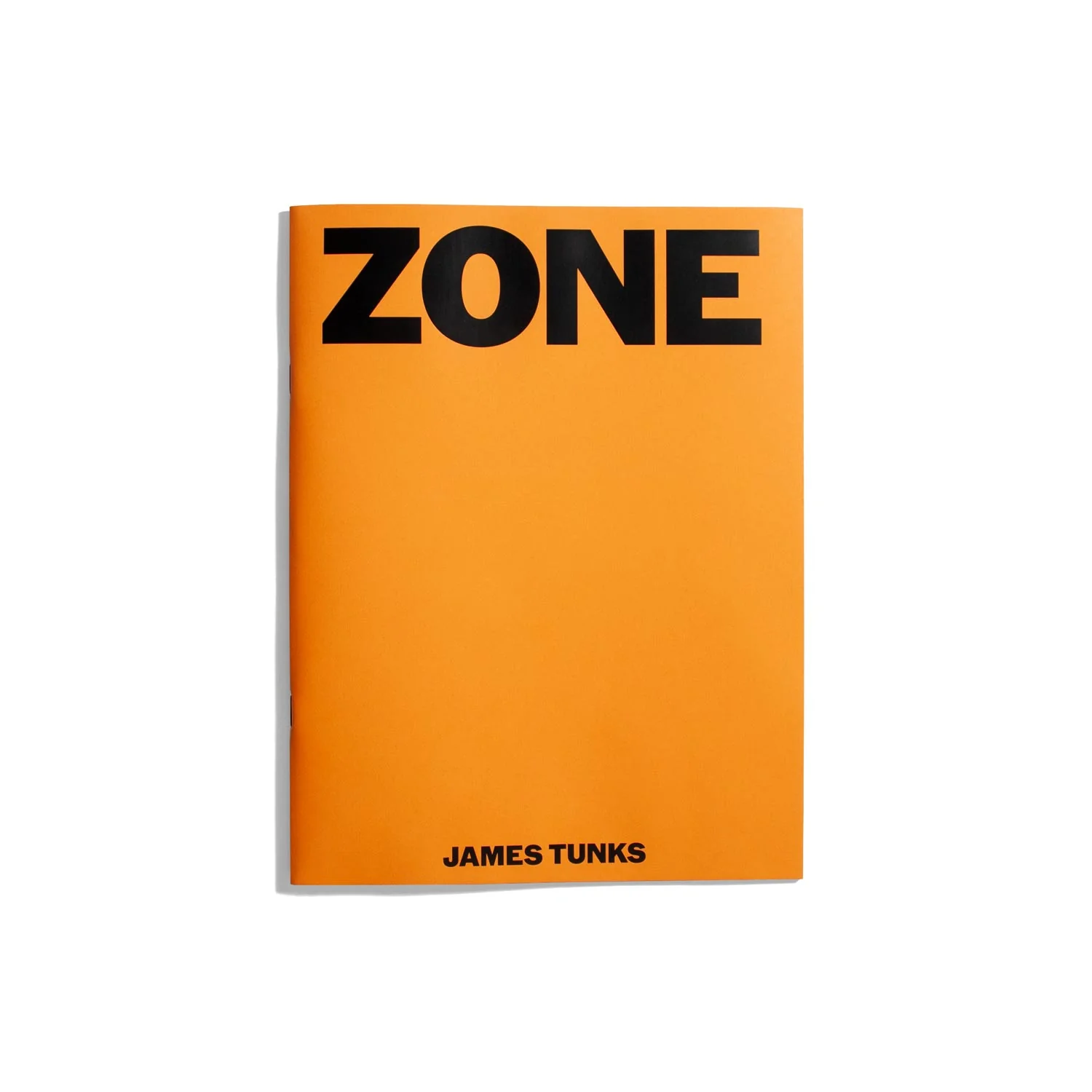
ZONE – Vienna-based Australian artist James Tunks’s third book with Perimeter Editions – seems to gesture towards this dynamic. Using flashes of searing colour as a foil for precise, meticulously detailed black and white, Tunks’s subjects and their underlying symbolism whisper to both the history and the present of the technological, explorative, concealed, and classified. Birds of prey and the Apollo Mission insignia sit alongside remote Icelandic landscapes used for lunar exploration research; blinding full-bleed images of the sun interrupt hyper-detailed telescopic photographs of the moon. Fragmented portraits reveal their own photographic processes; images echo, mirror, and double, offering shifting vantages, perspectives, and dissections.
Like his first book Into Dust (2017), which saw Tunks create fake astronomical photographs using pulverised camera lenses and philosophically loaded materials, and his 2022 book AI (Art Index), which used early machine learning to recast key works from art history, ZONE plays at the peripheries of new and old knowledge. An anonymous text at the conclusion of the book’s image sequence places its protagonist in a kind of fever dream. Alone, abroad, and in possession of a secret camera prototype of unimaginable image-making power (and great value to dangerous foreign actors), he considers the implications and sheer scope of the device’s advancements.
Produktinformationen
Produktinformationen
Versand & Rückgabe
Versand & Rückgabe
Description
Our philosophical understanding of the photograph may find its bearings in notions of time and the past, but our tools for making images are imbedded in the aggressive stride of technological innovation and forward thinking. Cameras now possess the ability to sense, capture, process, describe, augment, predict, and ‘think’, in increasingly pervasive ways. And like most computational devices, the camera is not immune to the disruptive forces of AI and machine learning.
ZONE – Vienna-based Australian artist James Tunks’s third book with Perimeter Editions – seems to gesture towards this dynamic. Using flashes of searing colour as a foil for precise, meticulously detailed black and white, Tunks’s subjects and their underlying symbolism whisper to both the history and the present of the technological, explorative, concealed, and classified. Birds of prey and the Apollo Mission insignia sit alongside remote Icelandic landscapes used for lunar exploration research; blinding full-bleed images of the sun interrupt hyper-detailed telescopic photographs of the moon. Fragmented portraits reveal their own photographic processes; images echo, mirror, and double, offering shifting vantages, perspectives, and dissections.
Like his first book Into Dust (2017), which saw Tunks create fake astronomical photographs using pulverised camera lenses and philosophically loaded materials, and his 2022 book AI (Art Index), which used early machine learning to recast key works from art history, ZONE plays at the peripheries of new and old knowledge. An anonymous text at the conclusion of the book’s image sequence places its protagonist in a kind of fever dream. Alone, abroad, and in possession of a secret camera prototype of unimaginable image-making power (and great value to dangerous foreign actors), he considers the implications and sheer scope of the device’s advancements.