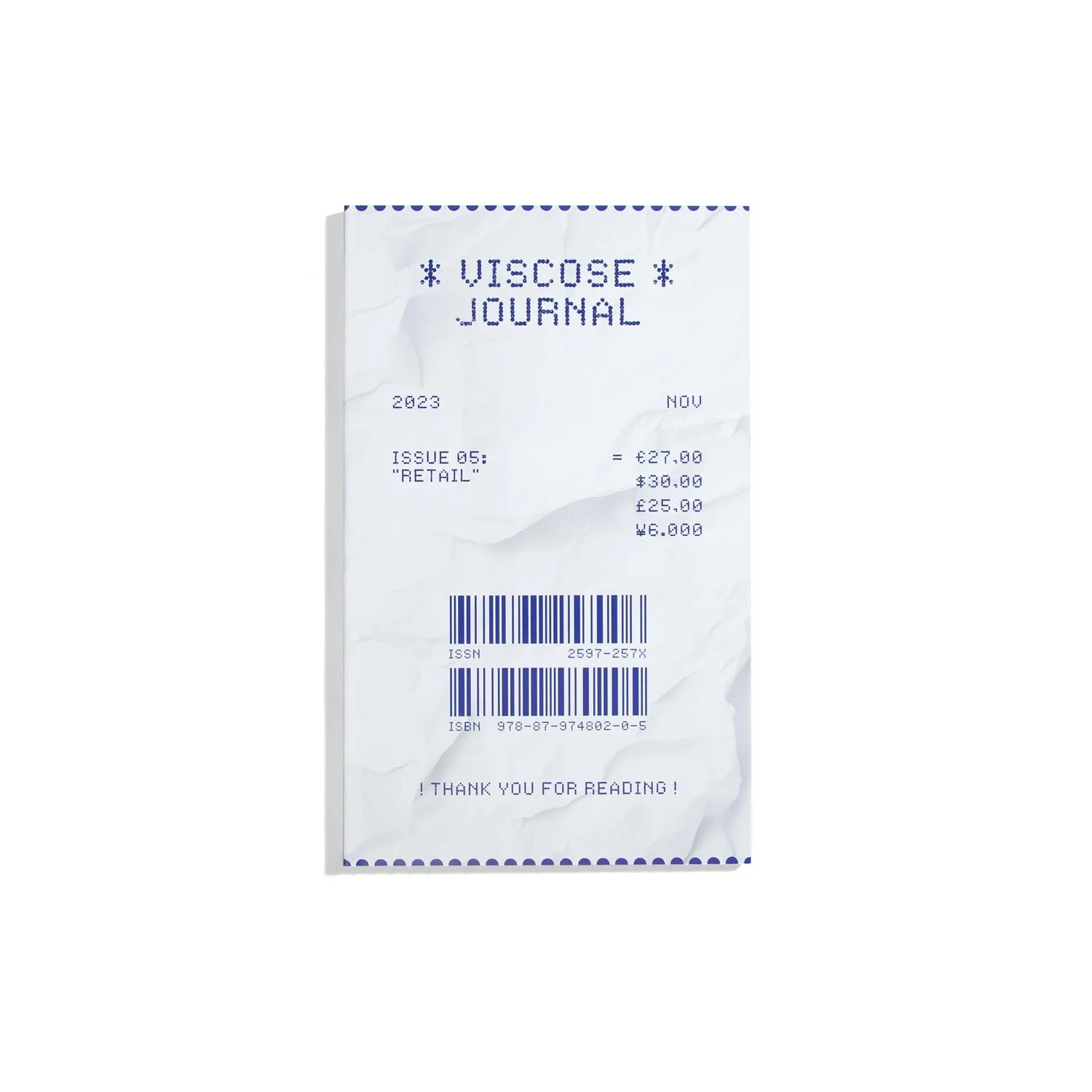
Viscose #5 2023 - Retail
The fifth issue of Viscose explores fashion’s multifaceted retail spaces and cultures. With the evolution of shopping in the 20th and 21st centuries as its focus, the issue looks at the shop as a central nexus where communities and identities are continuously produced and re-imagined through commerce. With a special attention to the role of fashion retail within urban spatial politics, we seek out histories of projects—often developed with or by artists—that have embraced the shop as a medium of both possibility and contestation. Retail is a central site of fashion production. It is in the store, mall, and e-shop that fashion products reveal the extent of the libidinal capitalist economy—a desire that has been theorized for centuries as commodity fetishism, a magical power relegated to objects as they enter circuits of exchange. As such, the shop is a stage for fashion’s oldest rituals, one that has become synonymous with capitalist modernity. Over the last century, shopping spaces have accelerated and mutated, into malls and department stores, re-imagining new types of public spaces structured by increasingly sublime architectures of consumption. As a public activity that demands (and thus commands) physical space, shopping continues to produce social relations that are deeply political in nature: gender, class, gentrification, surveillance, and police power are all ambiently produced and reproduced within retail spaces. As spaces dedicated to the reproduction of capital, retail necessitates systems, both formal and informal, of loss prevention and security that are embedded in physical infrastructure and embodied within consumers. As such, retail can be understood as sites of political contestation, transgression, and resistance, however quotidian or slight they may seem. We are studying retail in the aftermath of various proclaimed crises and revolutions—store death, retail apocalypse, digitization. Yet through these times, brick-and-mortar fashion consumption has not died but instead morphed in both appearance and function, serving today as sophisticated branding spaces in an aggressive experience economy. Retail, as we see it and know it in our contemporary moment, manically negotiates the ever-shifting relationship between contrasting spaces—urban, rural, virtual, invisible—and often prototypes infrastructures that are then adopted elsewhere in society.
Original: $31.79
-65%$31.79
$11.13Produktinformationen
Produktinformationen
Versand & Rückgabe
Versand & Rückgabe
Description
The fifth issue of Viscose explores fashion’s multifaceted retail spaces and cultures. With the evolution of shopping in the 20th and 21st centuries as its focus, the issue looks at the shop as a central nexus where communities and identities are continuously produced and re-imagined through commerce. With a special attention to the role of fashion retail within urban spatial politics, we seek out histories of projects—often developed with or by artists—that have embraced the shop as a medium of both possibility and contestation. Retail is a central site of fashion production. It is in the store, mall, and e-shop that fashion products reveal the extent of the libidinal capitalist economy—a desire that has been theorized for centuries as commodity fetishism, a magical power relegated to objects as they enter circuits of exchange. As such, the shop is a stage for fashion’s oldest rituals, one that has become synonymous with capitalist modernity. Over the last century, shopping spaces have accelerated and mutated, into malls and department stores, re-imagining new types of public spaces structured by increasingly sublime architectures of consumption. As a public activity that demands (and thus commands) physical space, shopping continues to produce social relations that are deeply political in nature: gender, class, gentrification, surveillance, and police power are all ambiently produced and reproduced within retail spaces. As spaces dedicated to the reproduction of capital, retail necessitates systems, both formal and informal, of loss prevention and security that are embedded in physical infrastructure and embodied within consumers. As such, retail can be understood as sites of political contestation, transgression, and resistance, however quotidian or slight they may seem. We are studying retail in the aftermath of various proclaimed crises and revolutions—store death, retail apocalypse, digitization. Yet through these times, brick-and-mortar fashion consumption has not died but instead morphed in both appearance and function, serving today as sophisticated branding spaces in an aggressive experience economy. Retail, as we see it and know it in our contemporary moment, manically negotiates the ever-shifting relationship between contrasting spaces—urban, rural, virtual, invisible—and often prototypes infrastructures that are then adopted elsewhere in society.