QSL? (Do You Confirm Receipt of My Transmission?)
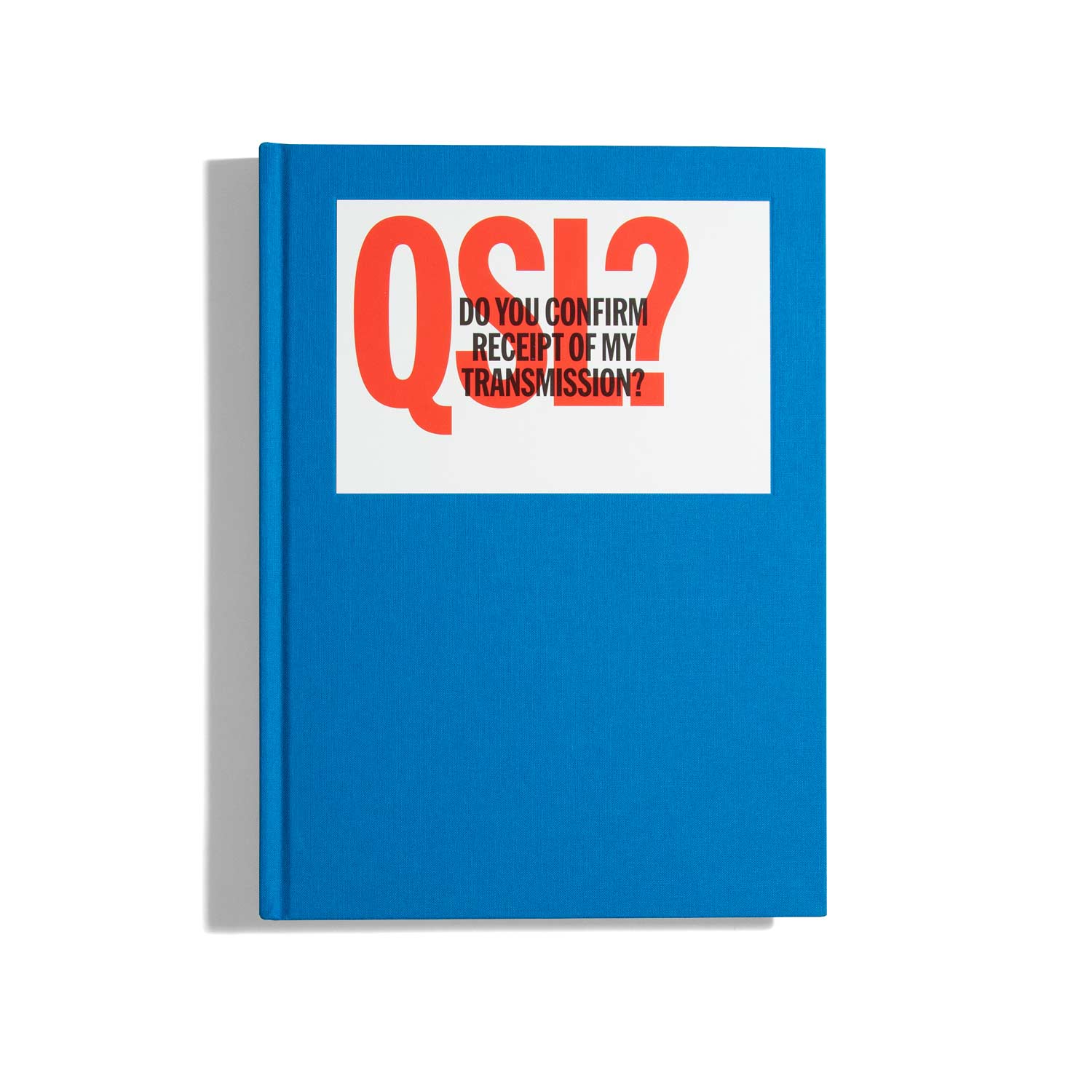
Communications between amateur radio (AKA ham radio) operators and citizen band stations have been crowding the world’s electromagnetic spectrum since its invention in the early 20th century. Millions of operators formed what could be almost be described as an early internet ― projecting their voices, ideas, and humanity around the earth’s surface using various techniques and frequencies to bounce their waves around the earth’s surface, off of the ionosphere, and even the moon. Any communication network needs a way of identifying individuals. A QSL card is a written confirmation of prior communication between two amateur radio or citizens band stations―postcard sized and mailed between users. Do You Confirm Receipt of My Transmission is derived from the Q code. A Q code message can stand for a statement or a question (when the code is followed by a question mark). In this case, ‘QSL?’ (note the question mark) means “Do you confirm receipt of my transmission?” while ‘QSL’ (without a question mark) means “I confirm receipt of your transmission.” Just like today’s internet avatars, operators had their own style and often projected their personality using their QSL cards. Collecting cards was popular, and a source of pride to operators. Published by Brooklyn-based design imprint, Standards Manual, Do You Confirm Receipt of My Transmission is a visual history of these cards, spanning from approximately 1960–1990. Over 190 cards are included, front and back, with high resolution details. The collection forms a visual history of early global communication ― something we now take for granted but was once a marvel. Today, there are over 3 million licensed radio operators worldwide.
Produktinformationen
Produktinformationen
Versand & Rückgabe
Versand & Rückgabe
Description
Communications between amateur radio (AKA ham radio) operators and citizen band stations have been crowding the world’s electromagnetic spectrum since its invention in the early 20th century. Millions of operators formed what could be almost be described as an early internet ― projecting their voices, ideas, and humanity around the earth’s surface using various techniques and frequencies to bounce their waves around the earth’s surface, off of the ionosphere, and even the moon. Any communication network needs a way of identifying individuals. A QSL card is a written confirmation of prior communication between two amateur radio or citizens band stations―postcard sized and mailed between users. Do You Confirm Receipt of My Transmission is derived from the Q code. A Q code message can stand for a statement or a question (when the code is followed by a question mark). In this case, ‘QSL?’ (note the question mark) means “Do you confirm receipt of my transmission?” while ‘QSL’ (without a question mark) means “I confirm receipt of your transmission.” Just like today’s internet avatars, operators had their own style and often projected their personality using their QSL cards. Collecting cards was popular, and a source of pride to operators. Published by Brooklyn-based design imprint, Standards Manual, Do You Confirm Receipt of My Transmission is a visual history of these cards, spanning from approximately 1960–1990. Over 190 cards are included, front and back, with high resolution details. The collection forms a visual history of early global communication ― something we now take for granted but was once a marvel. Today, there are over 3 million licensed radio operators worldwide.