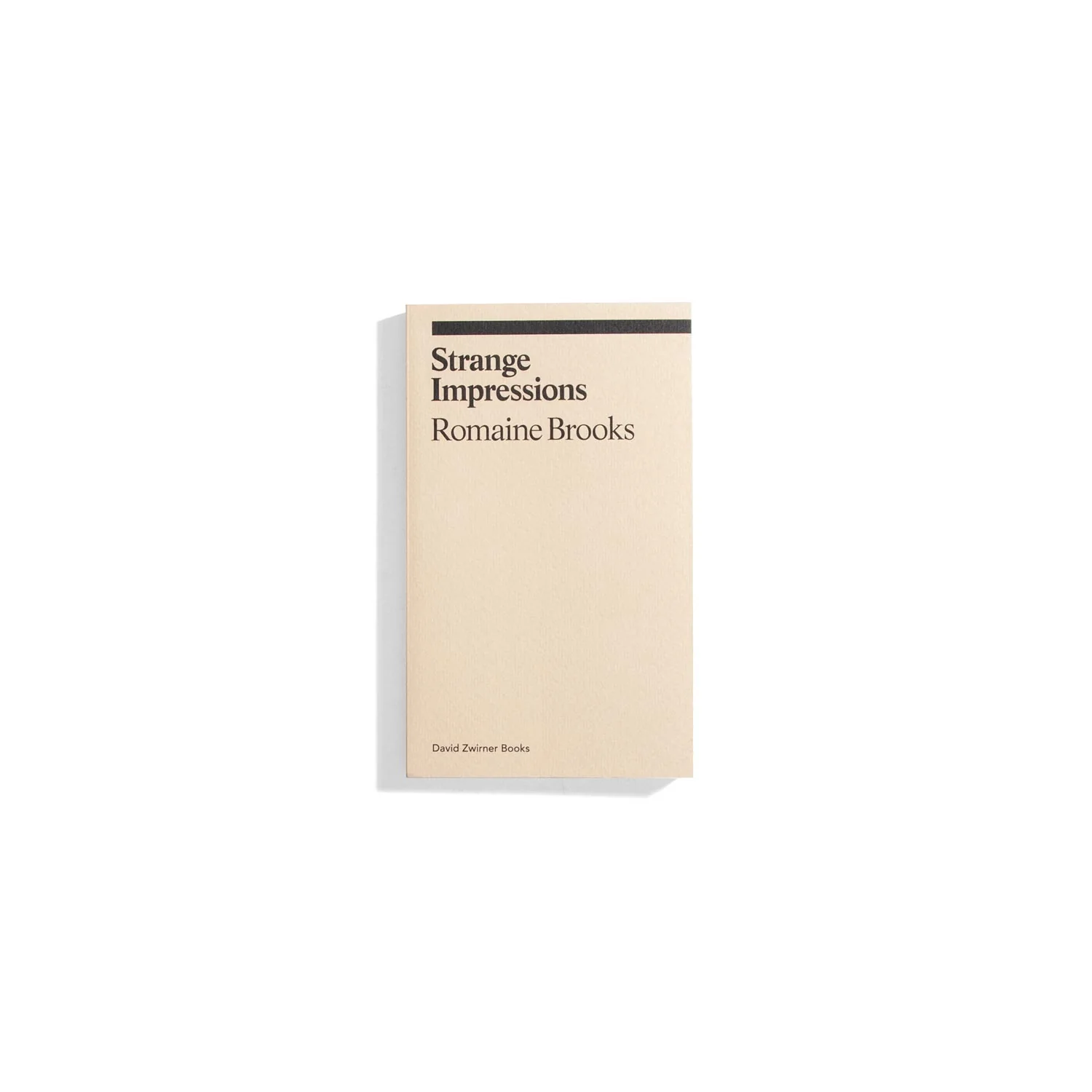
Strange Impressions - Romaine Brooks (ekphrasis series)
Selections from Romaine Brooks’s unpublished memoir No Pleasant Memories expose the psyche and practice of this underrecognized queer, female artist.
Most known for her bold and darkly painted portraits, Brooks was revolutionary in her feminist renderings of women in resistance. Openly queer, she challenged conceptions of gender and sexuality in her art, which also served as her refuge. While many of her male counterparts were disfiguring and cubing their subjects—often women—Brooks gave personhood and power to the figures she painted. Her frank approach to her complicated relationship with her mother, faith, wealth, sexuality, and gender is complemented by a keen wit that echoes the gray tones of her work.
Though her paintings are held in major collections, Brooks’s influence in modernist circles of the early twentieth century is largely underexplored. This new publication, guided by Brooks’s own impressionistic musings, bridges an important gap between the art and the artist. An introduction by Lauren O’Neill-Butler explores Brooks’s role as an artist in the early twentieth century through the lens of gender and sexuality.
Produktinformationen
Produktinformationen
Versand & Rückgabe
Versand & Rückgabe
Description
Selections from Romaine Brooks’s unpublished memoir No Pleasant Memories expose the psyche and practice of this underrecognized queer, female artist.
Most known for her bold and darkly painted portraits, Brooks was revolutionary in her feminist renderings of women in resistance. Openly queer, she challenged conceptions of gender and sexuality in her art, which also served as her refuge. While many of her male counterparts were disfiguring and cubing their subjects—often women—Brooks gave personhood and power to the figures she painted. Her frank approach to her complicated relationship with her mother, faith, wealth, sexuality, and gender is complemented by a keen wit that echoes the gray tones of her work.
Though her paintings are held in major collections, Brooks’s influence in modernist circles of the early twentieth century is largely underexplored. This new publication, guided by Brooks’s own impressionistic musings, bridges an important gap between the art and the artist. An introduction by Lauren O’Neill-Butler explores Brooks’s role as an artist in the early twentieth century through the lens of gender and sexuality.