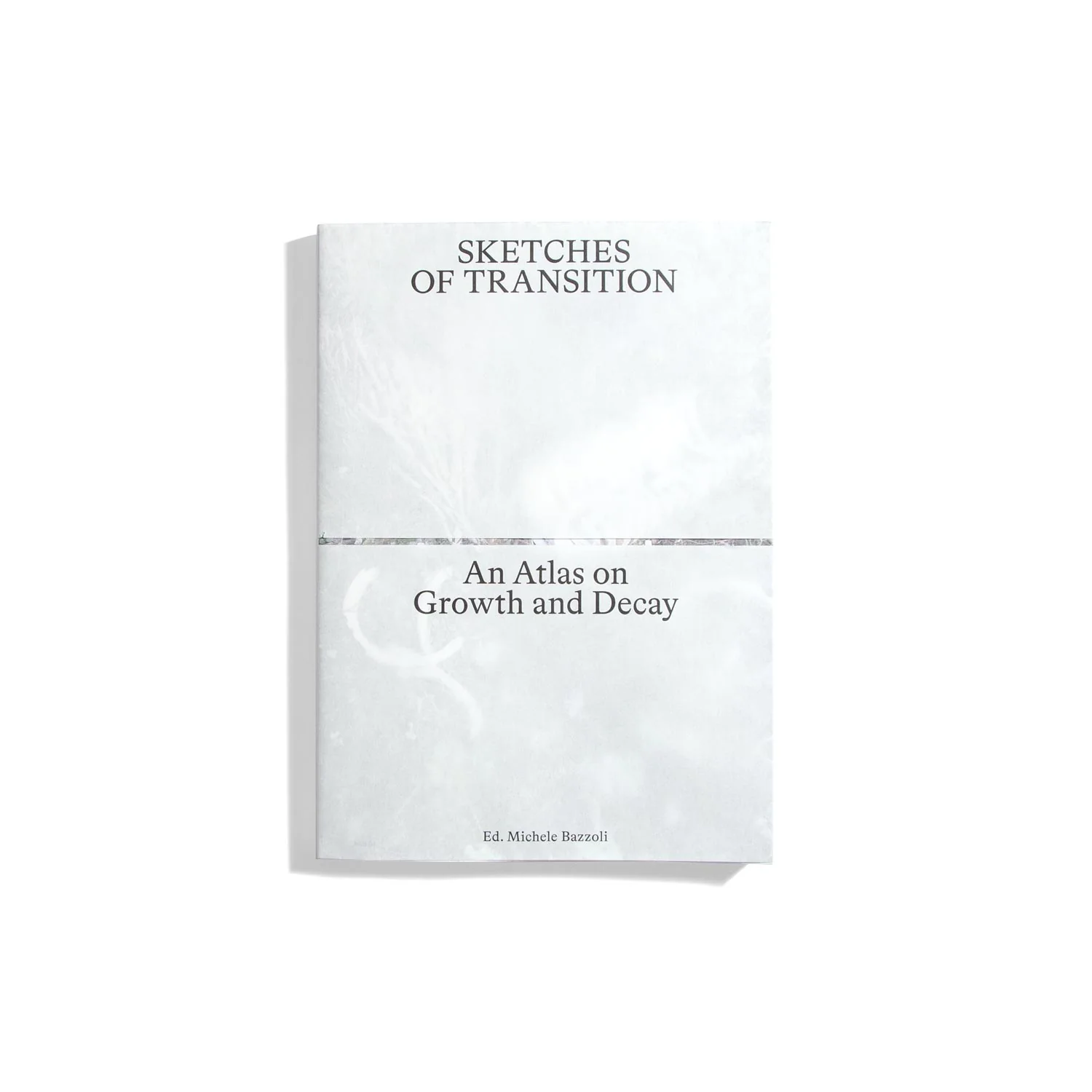
Sketches of Transition: An Atlas on Growth and Decay
Unlike traditional approaches that would produce a book or catalogue to document the artworks on show, this exhibition wants to transform the very essence of the book Sketches of Transition – An Atlas on Growth and Decay into a spatial experience.
Drawing inspiration from its atlas structure, a curated selection of printed works is showcased. These prints, functioning as maps, extend the book’s topography into the architectural canvas of the space, inviting the viewer to immerse in an interactive encounter with the atlas’s content.
Alongside these two-dimensional elements is a selection of sculptural works, which don’t present themselves as finished artworks, but rather as the molds onto which the pages were casted, subtly referring to the way in which their images are built in layers of paper, ink, and transparency.
Gazing through the various apertures of the featured researches, each chapter of the book could be considered a sketch of transition in itself, as an annotation on an alternative perspective on the material and visual spheres of our existences. In this sense, this exhibition can be seen as an extension of those sketches, which with the freedom of a blank paper sheet investigate and probe new modes of production of beauty and wonder.
Original: $38.27
-65%$38.27
$13.39Produktinformationen
Produktinformationen
Versand & Rückgabe
Versand & Rückgabe
Description
Unlike traditional approaches that would produce a book or catalogue to document the artworks on show, this exhibition wants to transform the very essence of the book Sketches of Transition – An Atlas on Growth and Decay into a spatial experience.
Drawing inspiration from its atlas structure, a curated selection of printed works is showcased. These prints, functioning as maps, extend the book’s topography into the architectural canvas of the space, inviting the viewer to immerse in an interactive encounter with the atlas’s content.
Alongside these two-dimensional elements is a selection of sculptural works, which don’t present themselves as finished artworks, but rather as the molds onto which the pages were casted, subtly referring to the way in which their images are built in layers of paper, ink, and transparency.
Gazing through the various apertures of the featured researches, each chapter of the book could be considered a sketch of transition in itself, as an annotation on an alternative perspective on the material and visual spheres of our existences. In this sense, this exhibition can be seen as an extension of those sketches, which with the freedom of a blank paper sheet investigate and probe new modes of production of beauty and wonder.