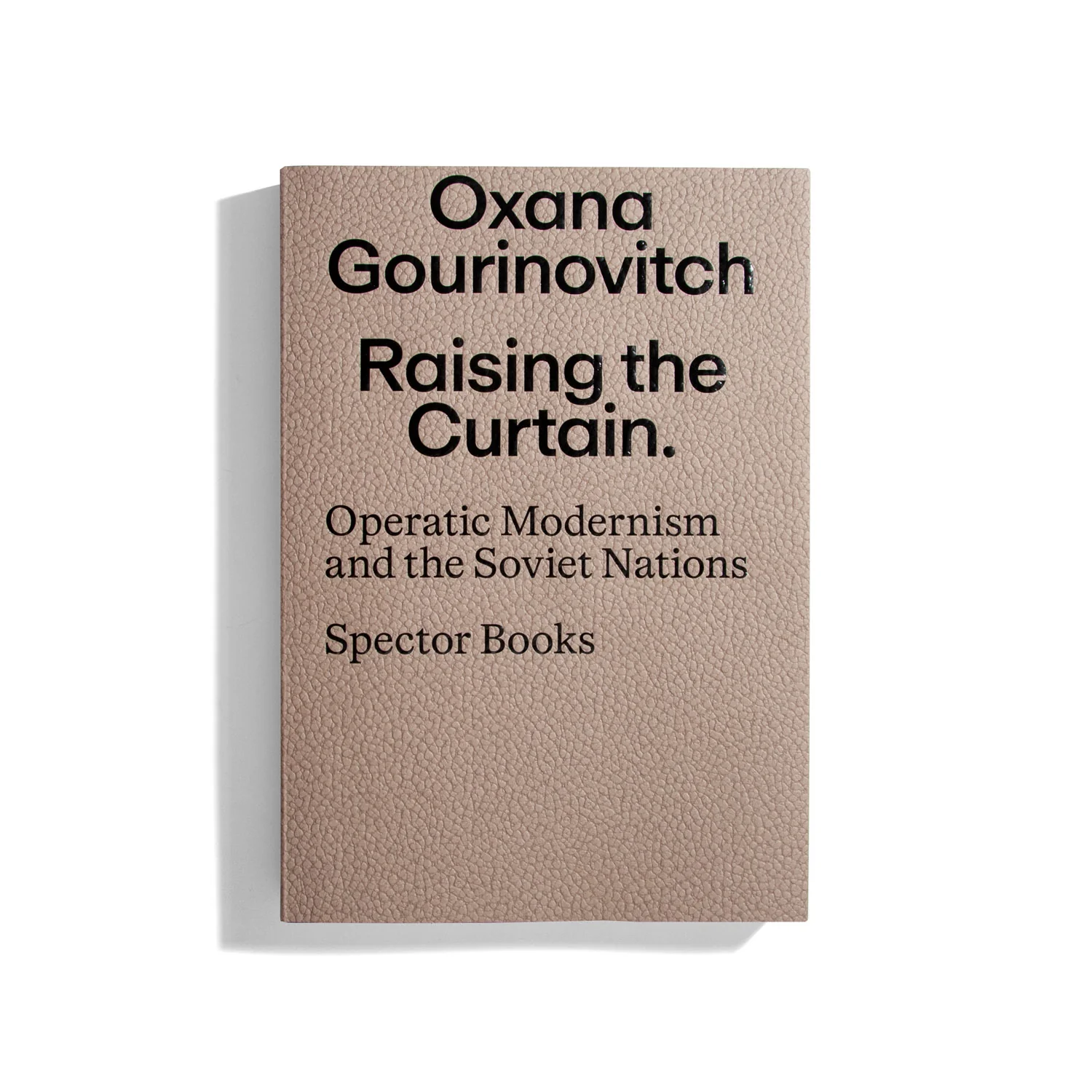
Raising The Curtain - Oxana Gourinovitch
The book revolves around two modernist opera theatres—designed by two leading female architects—that stand on the Soviet periphery, in Lithuania and Belarus: the Opera and Ballet Theatre in Vilnius (1962–74) by Nijole Bučiūtė and the Comic Opera in Minsk (1973–81) by Oxana Tkachuk. The book reconstructs the history of how each theatre was commissioned, planned, and built; it also uses their contextualization as a means to examine the contemporary political and cultural events that had been unfolding on the stages of the Republics prior to and at the time of the theatres’ creation. The book looks at how modernist architecture co-created and conveyed the self-imaginaries of the “new nations” of Belarus and Lithuania. By addressing the long-neglected processes of nation-building within the Soviet Union and the way built environments were involved in this, it helps comprehend the forces that propelled the Soviet Union towards its collapse, while placing architecture’s entanglement with them centre stage.
Original: $49.46
-65%$49.46
$17.31Produktinformationen
Produktinformationen
Versand & Rückgabe
Versand & Rückgabe
Description
The book revolves around two modernist opera theatres—designed by two leading female architects—that stand on the Soviet periphery, in Lithuania and Belarus: the Opera and Ballet Theatre in Vilnius (1962–74) by Nijole Bučiūtė and the Comic Opera in Minsk (1973–81) by Oxana Tkachuk. The book reconstructs the history of how each theatre was commissioned, planned, and built; it also uses their contextualization as a means to examine the contemporary political and cultural events that had been unfolding on the stages of the Republics prior to and at the time of the theatres’ creation. The book looks at how modernist architecture co-created and conveyed the self-imaginaries of the “new nations” of Belarus and Lithuania. By addressing the long-neglected processes of nation-building within the Soviet Union and the way built environments were involved in this, it helps comprehend the forces that propelled the Soviet Union towards its collapse, while placing architecture’s entanglement with them centre stage.