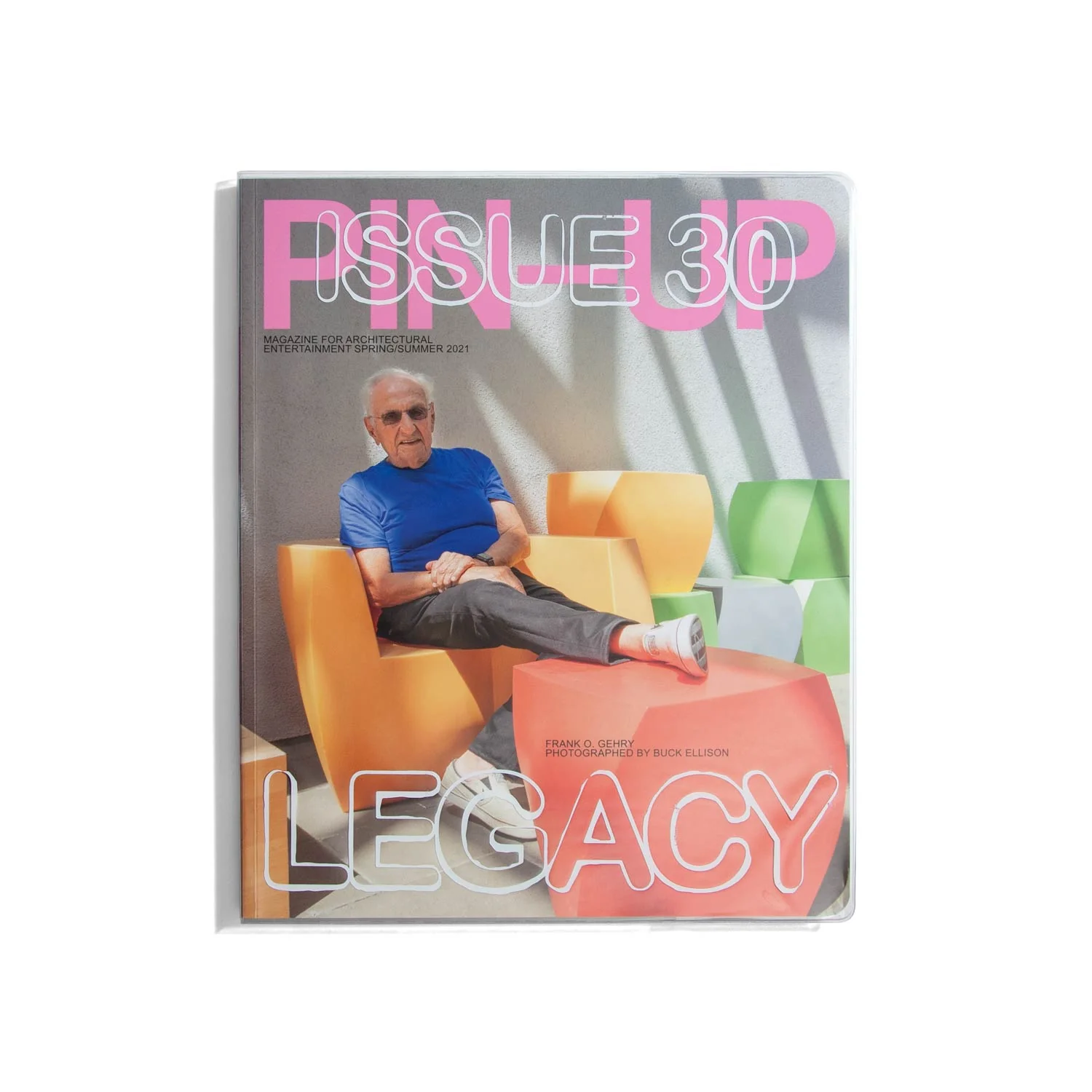
Pin-Up #30 S/S 2021
The Anniversary issue comes with two Covers. In 2006, George W. Bush was president and mainstream architecture was a sober business for serious men. When the first issue of PIN–UP came out in October of that year, it hit different. moreThe combination of Zaha Hadid meets Rick Owens’s post-coital bed meets phallic skyscraper prostheses on the cover was startling to many and the “architectural entertainment” byline collided words and worlds in a way that, to the design establishment, seemed frivolous at best. PIN–UP employed “entertainment” as a queering agent, a sensibility the architecture scene badly needed, while the vision it fostered was defiantly inclusive, an uninhibited space for a diversity of voices to empathetically coexist, all wrapped up in a rule-bending graphic package. 15 years later the reality of the design world has slowly caught up with PIN–UP’s early vision, as new generations push for change and representation at every level and challenge the role of traditional gatekeepers (RIP the architecture critic). As mainstream culture shifted, architecture as entertainment no longer seems so controversial, with a digital chorus line of grid-friendly design porn constantly hustling for our attention. In the fragmented post-Internet landscape, PIN–UP’s role has undergone a subtle evolution, from playful subverter of a waning status quo to connective agent, bringing together creative and intellectual micro clusters. This is true for all platforms, but especially for print, whose relative slowness brings things into perspective, allowing the time to identify the not-so-obvious connections that culturally help move the needle forward. PIN–UP might look all glossy now, but we owe our love for printed matter to the history of zine culture, and as such we always saw it more as a statement than a business model. Thirty issues later, PIN–UP’s printed legacy has been spared the accelerated obsolescence of the digital archive (so long Adobe Flash!) as it now presents an irreverent chronicle of architecture and design production of the first two decades of the 21st century. From a personal point of view, what continues to be the most inspiring is the community that has grown around the magazine: the people who read PIN–UP, the people featured in PIN–UP, and the people who make PIN–UP — internationally and especially in New York, the city on whose fuel all issues run. If we’re still here in 15 years, it’ll be thanks to you.
Original: $29.44
-65%$29.44
$10.30Produktinformationen
Produktinformationen
Versand & Rückgabe
Versand & Rückgabe
Description
The Anniversary issue comes with two Covers. In 2006, George W. Bush was president and mainstream architecture was a sober business for serious men. When the first issue of PIN–UP came out in October of that year, it hit different. moreThe combination of Zaha Hadid meets Rick Owens’s post-coital bed meets phallic skyscraper prostheses on the cover was startling to many and the “architectural entertainment” byline collided words and worlds in a way that, to the design establishment, seemed frivolous at best. PIN–UP employed “entertainment” as a queering agent, a sensibility the architecture scene badly needed, while the vision it fostered was defiantly inclusive, an uninhibited space for a diversity of voices to empathetically coexist, all wrapped up in a rule-bending graphic package. 15 years later the reality of the design world has slowly caught up with PIN–UP’s early vision, as new generations push for change and representation at every level and challenge the role of traditional gatekeepers (RIP the architecture critic). As mainstream culture shifted, architecture as entertainment no longer seems so controversial, with a digital chorus line of grid-friendly design porn constantly hustling for our attention. In the fragmented post-Internet landscape, PIN–UP’s role has undergone a subtle evolution, from playful subverter of a waning status quo to connective agent, bringing together creative and intellectual micro clusters. This is true for all platforms, but especially for print, whose relative slowness brings things into perspective, allowing the time to identify the not-so-obvious connections that culturally help move the needle forward. PIN–UP might look all glossy now, but we owe our love for printed matter to the history of zine culture, and as such we always saw it more as a statement than a business model. Thirty issues later, PIN–UP’s printed legacy has been spared the accelerated obsolescence of the digital archive (so long Adobe Flash!) as it now presents an irreverent chronicle of architecture and design production of the first two decades of the 21st century. From a personal point of view, what continues to be the most inspiring is the community that has grown around the magazine: the people who read PIN–UP, the people featured in PIN–UP, and the people who make PIN–UP — internationally and especially in New York, the city on whose fuel all issues run. If we’re still here in 15 years, it’ll be thanks to you.