Master of Voice
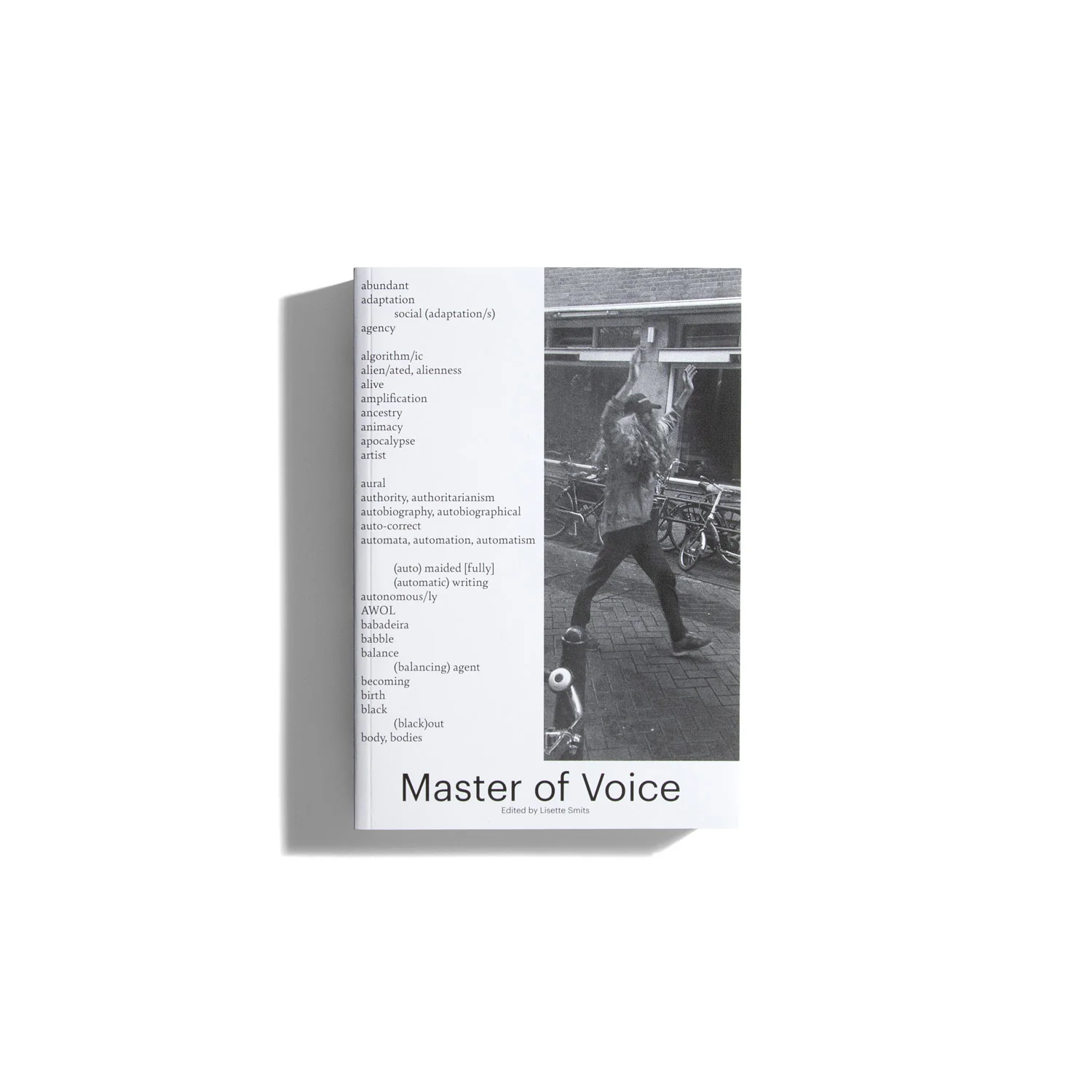
The (non)human voice has always been part of modern art, notably within performance art, sound art, and conceptual art. However, Master of Voice temporary master program at the Gerrit Rietveld Academy, Amsterdam, mutated from this history, examining the voice as a unique “discipline.” moreThe graduate program’s focus was on the (non)human voice as a means to an end or an end in itself within artistic practice. A special orientation of the curriculum, co-developed with a team of artists with a longstanding interest in the (non)human voice, is the voice in relation to technology and gender. This book captures a two-year-long period of research—of thinking, talking, sharing, learning, making, acting, and creating by students and teachers, artists, and other practitioners—to find possible answers and approaches to the question of the voice and its prominent role in our postindustrial society. Contributions by TYLER COBURN, ANGELO CUSTÓDIO, THOM DRIVER, PAUL ELLIMAN, AMELIA GROOM, MIYUKI INOUE, DANAE IO, JAMILA JOHNSON-SMALL, BIN KOH, SNEJANKA MIHAYLOVA, MARIA MONTESI, MPA, NATASHA PAPADOPOULOU, DUNCAN ROBERTSON, MARNIE SLATER, CÉCILE TAFANELLI, MAVI VELOSO, GEO WYETH, EVA ŠUSOVÁ
Produktinformationen
Produktinformationen
Versand & Rückgabe
Versand & Rückgabe
Description
The (non)human voice has always been part of modern art, notably within performance art, sound art, and conceptual art. However, Master of Voice temporary master program at the Gerrit Rietveld Academy, Amsterdam, mutated from this history, examining the voice as a unique “discipline.” moreThe graduate program’s focus was on the (non)human voice as a means to an end or an end in itself within artistic practice. A special orientation of the curriculum, co-developed with a team of artists with a longstanding interest in the (non)human voice, is the voice in relation to technology and gender. This book captures a two-year-long period of research—of thinking, talking, sharing, learning, making, acting, and creating by students and teachers, artists, and other practitioners—to find possible answers and approaches to the question of the voice and its prominent role in our postindustrial society. Contributions by TYLER COBURN, ANGELO CUSTÓDIO, THOM DRIVER, PAUL ELLIMAN, AMELIA GROOM, MIYUKI INOUE, DANAE IO, JAMILA JOHNSON-SMALL, BIN KOH, SNEJANKA MIHAYLOVA, MARIA MONTESI, MPA, NATASHA PAPADOPOULOU, DUNCAN ROBERTSON, MARNIE SLATER, CÉCILE TAFANELLI, MAVI VELOSO, GEO WYETH, EVA ŠUSOVÁ