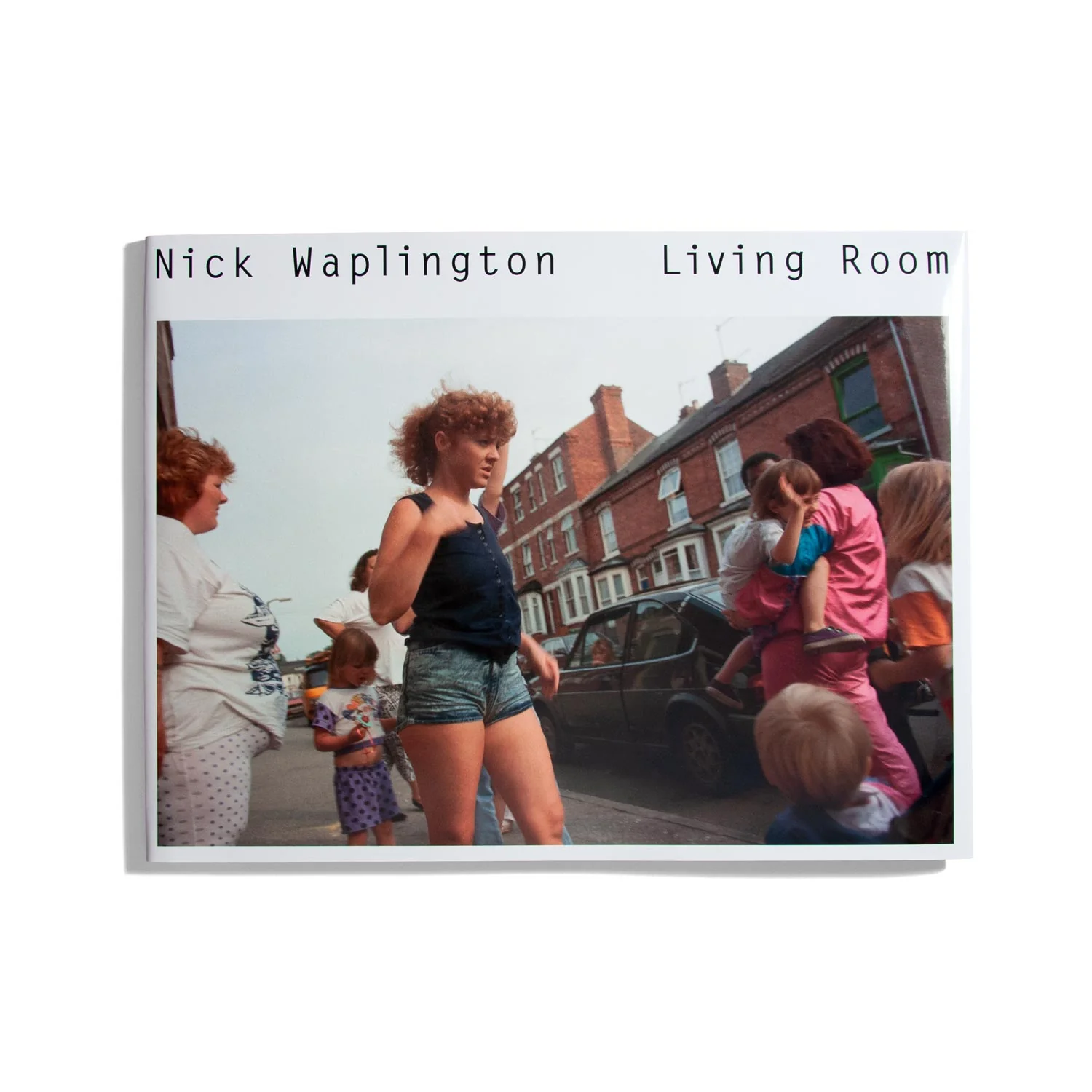
Living Room - Nick Waplington
Nick Waplington’s first book, Living Room, was published in 1991, and was an instant
sensation within the photography world and beyond. The 59 photographs in the original
edition documented the lives of friends, families, and neighbours on the Broxtowe housing
estate in Nottingham, England, where Waplington spent many years making thousands of
images. This extensive archive of unseen photographs forms the basis of this new
conceptual remake of the 1991 monograph, one that revisits and refashions Waplington’s
iconic work from a contemporary vantage point. This new work follows the same
sequencing of landscape and portrait images as the original edition – replacing each of the
59 photographs with an as-yet-unseen work from the Living Room archive, often from the
same roll of film as the original image. The result is both familiar and uncanny, a vivid
journey back to Thatcher’s Britain and a testament to the decades of art and life that have
elapsed between then and now.
Whilst Waplington’s early work was intrinsically rooted in ‘documentary’ practice, it also
challenged the conventional documentary gaze. Simon Baker, director of Maison
Européenne de la Photographie, importantly notes that Waplington employs a deeply
humanistic approach which is resistant to voyeuristic or intrusive documentation. Indeed,
Baker states: “Waplington is broadly curious and deeply committed in his work, and as
serious about family life as politics or art, or music and the social cultures around it, but
always as both witness and participant”, a method which achieves his simultaneous intimacy
and invisibility.
Original: $103.04
-65%$103.04
$36.06Produktinformationen
Produktinformationen
Versand & Rückgabe
Versand & Rückgabe
Description
Nick Waplington’s first book, Living Room, was published in 1991, and was an instant
sensation within the photography world and beyond. The 59 photographs in the original
edition documented the lives of friends, families, and neighbours on the Broxtowe housing
estate in Nottingham, England, where Waplington spent many years making thousands of
images. This extensive archive of unseen photographs forms the basis of this new
conceptual remake of the 1991 monograph, one that revisits and refashions Waplington’s
iconic work from a contemporary vantage point. This new work follows the same
sequencing of landscape and portrait images as the original edition – replacing each of the
59 photographs with an as-yet-unseen work from the Living Room archive, often from the
same roll of film as the original image. The result is both familiar and uncanny, a vivid
journey back to Thatcher’s Britain and a testament to the decades of art and life that have
elapsed between then and now.
Whilst Waplington’s early work was intrinsically rooted in ‘documentary’ practice, it also
challenged the conventional documentary gaze. Simon Baker, director of Maison
Européenne de la Photographie, importantly notes that Waplington employs a deeply
humanistic approach which is resistant to voyeuristic or intrusive documentation. Indeed,
Baker states: “Waplington is broadly curious and deeply committed in his work, and as
serious about family life as politics or art, or music and the social cultures around it, but
always as both witness and participant”, a method which achieves his simultaneous intimacy
and invisibility.