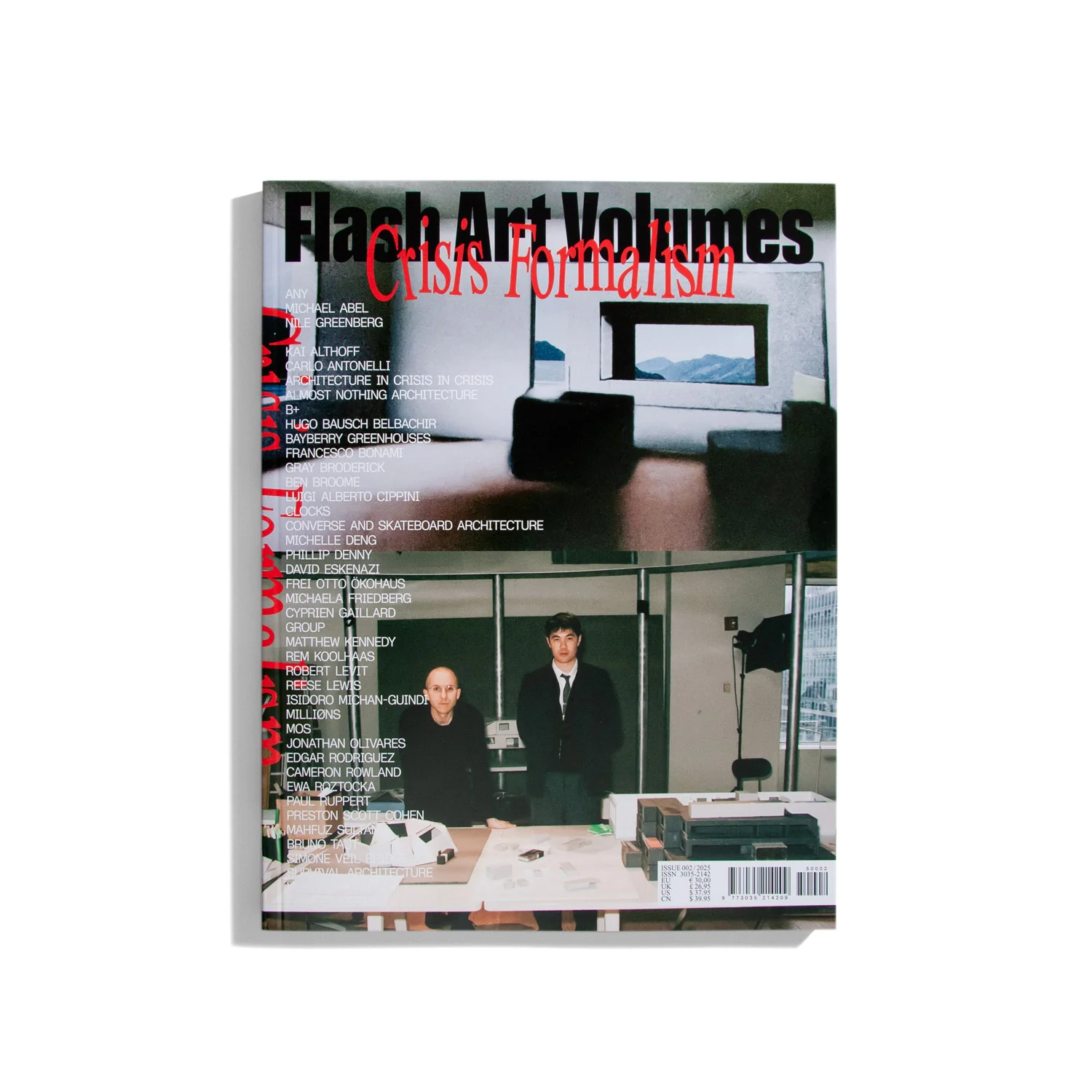
Flash Art Volumes - Issue #2
For its second issue, Flash Art Volumes invited Michael Abel and Nile Greenberg of the New York–based architecture practice ANY as guest editors. They have titled this edition “Crisis Formalism.”
If we recognize that architecture is at a tipping point – in which form, once immediate and vital, risks dissolving into a haze of proliferating crises – then the moment calls for a fundamental rethinking of form itself, not as an outcome of crisis but as its very cause. Crisis has long unsettled architecture: modernists, postmodernists, deconstructivists, and parametricists each declared a state of emergency in which the discipline faltered. Still, a recurring twentieth-century question remains: Can architecture act politically in response to crisis – whether in housing, civic identity, or technological shifts?
Today’s crises, however, are entangled in broader complexities. The contemporary world is defined by what French philosopher Edgar Morin termed “polycrisis” –– a web of interlinked emergencies that confound both institutional structures and inherited architectural frameworks. Whereas architecture once aspired to generate stable meaning, today’s swirl of economic, environmental, and political disruptions has undermined that assumption. In response, some retreat from architecture into policy, finance, or material logistics. Yet, rather than diminishing architecture’s cultural potency, these challenges invite a renewed engagement with form.
“Crisis Formalism” proposes that form – often reduced to mere aesthetic expression – can become the site where crisis is contained, concentrated, and transformed into new architectural possibilities. What, then, are the formal implications of crisis?
Historically, crises have shaped architectural forms in profound ways. Consider the Kaiping Diaolou in Guangdong, China: a network of more than 1,800 fortified towers that emerged from intersecting crises – bandit raids, seasonal food shortages, forced migration, economic upheaval, and cross-cultural exchanges. Built between 1900 and 1931, these structures combined defensive features (fortified walls, elevated entries) with Western stylistic influences, reflecting the hybrid identities of returning Chinese laborers who had faced exclusionary policies abroad. These structures embodied crisis as an architectural force, demonstrating how multiple disruptions converse to generate new forms.
“Crisis Formalism” stands on a dual premise: first, that architectural form has lost its immediacy and resonance; second, that contemporary crises require more than reactive solutions. If architects address crises in isolation – whether geopolitical, financial, or environmental – designs unravel under the weight of their interdependencies. Morin warns that fragmented, reductionist thinking produces a blindness that leaves architecture complicit in the very crises it seeks to mitigate.
Produktinformationen
Produktinformationen
Versand & Rückgabe
Versand & Rückgabe
Description
For its second issue, Flash Art Volumes invited Michael Abel and Nile Greenberg of the New York–based architecture practice ANY as guest editors. They have titled this edition “Crisis Formalism.”
If we recognize that architecture is at a tipping point – in which form, once immediate and vital, risks dissolving into a haze of proliferating crises – then the moment calls for a fundamental rethinking of form itself, not as an outcome of crisis but as its very cause. Crisis has long unsettled architecture: modernists, postmodernists, deconstructivists, and parametricists each declared a state of emergency in which the discipline faltered. Still, a recurring twentieth-century question remains: Can architecture act politically in response to crisis – whether in housing, civic identity, or technological shifts?
Today’s crises, however, are entangled in broader complexities. The contemporary world is defined by what French philosopher Edgar Morin termed “polycrisis” –– a web of interlinked emergencies that confound both institutional structures and inherited architectural frameworks. Whereas architecture once aspired to generate stable meaning, today’s swirl of economic, environmental, and political disruptions has undermined that assumption. In response, some retreat from architecture into policy, finance, or material logistics. Yet, rather than diminishing architecture’s cultural potency, these challenges invite a renewed engagement with form.
“Crisis Formalism” proposes that form – often reduced to mere aesthetic expression – can become the site where crisis is contained, concentrated, and transformed into new architectural possibilities. What, then, are the formal implications of crisis?
Historically, crises have shaped architectural forms in profound ways. Consider the Kaiping Diaolou in Guangdong, China: a network of more than 1,800 fortified towers that emerged from intersecting crises – bandit raids, seasonal food shortages, forced migration, economic upheaval, and cross-cultural exchanges. Built between 1900 and 1931, these structures combined defensive features (fortified walls, elevated entries) with Western stylistic influences, reflecting the hybrid identities of returning Chinese laborers who had faced exclusionary policies abroad. These structures embodied crisis as an architectural force, demonstrating how multiple disruptions converse to generate new forms.
“Crisis Formalism” stands on a dual premise: first, that architectural form has lost its immediacy and resonance; second, that contemporary crises require more than reactive solutions. If architects address crises in isolation – whether geopolitical, financial, or environmental – designs unravel under the weight of their interdependencies. Morin warns that fragmented, reductionist thinking produces a blindness that leaves architecture complicit in the very crises it seeks to mitigate.