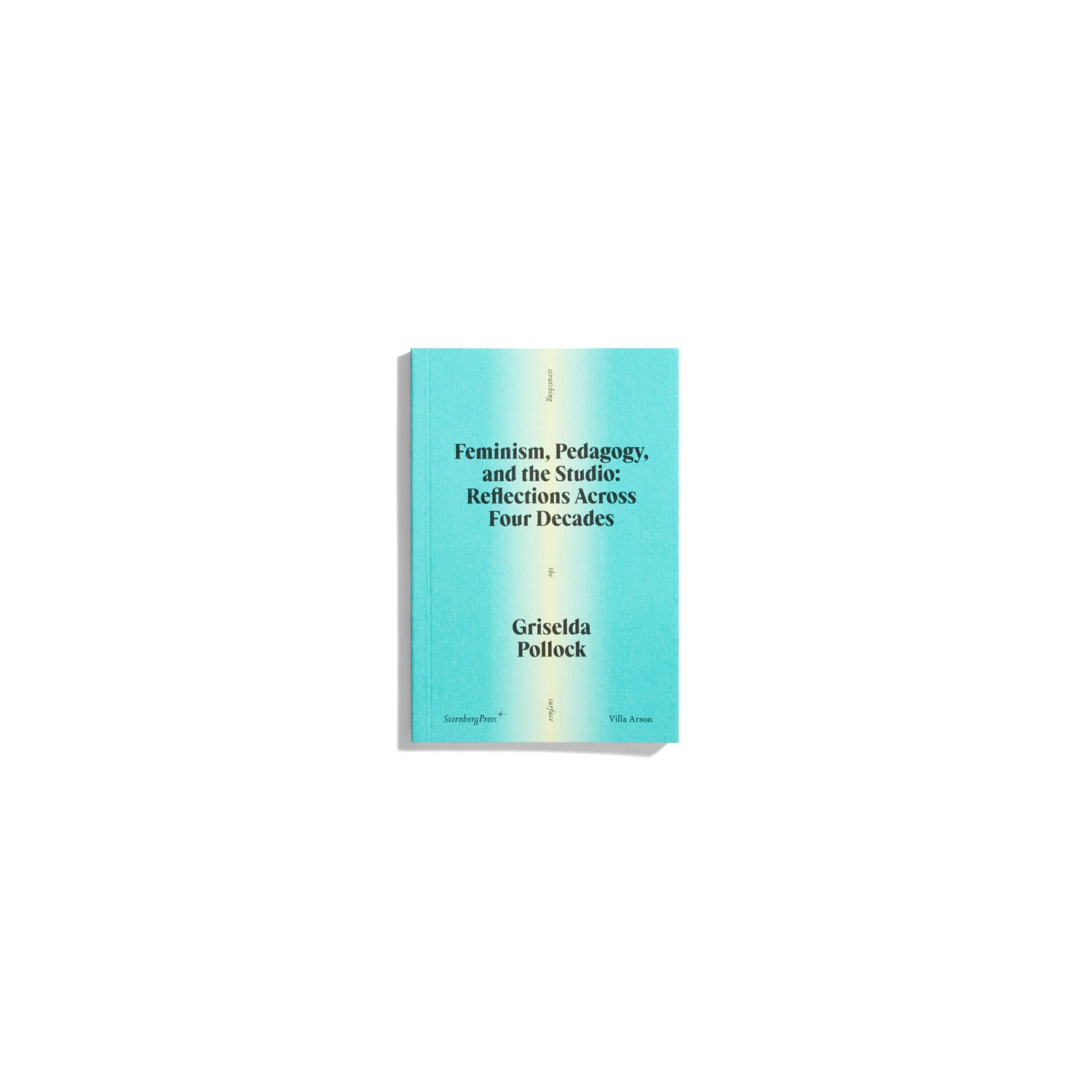
Feminism, Pedagogy and the Studio: Reflections Across Four Decades - Griselda Pollock
Feminism, Pedagogy, and the Studio: Reflections Across Four Decades brings together two lectures delivered by feminist art historian and curator Griselda Pollock in 1985 and 2022.
In 1985, Griselda Pollock critically examined the gender politics of twentieth-century art education that, she argued, reinforced masculinist and individualist ideologies within capitalist conditions of artistic production. She linked the cult of authorship to the non recognition of women as artists, even in the face of the evidence of women’s considerable participation in modern art. She explored the impact of a critical post-modern and feminist artistic engagement with theories of meaning, subjectivity, and the image drawn from outside the “studio” model. She ultimately proposed “feminist interventions in art’s histories,” where expanded histories—including race, class, gender, and sexuality—challenge both the monographic-all-male model of the hero artist and the hegemony of formalist art theory.
Almost forty years later, in 2022, she revisited the impact of “1968” and its theoretical revolution. She historically situates the major geopolitical and ideological shifts since 1989 (The Fall of the Berlin Wall) and 2001 (9/11), and notably since 2007 the touch-screen phone (linking to the internet and social media). She identifies a troubling cultural tendency post-2010 that, with thanks to Derrida, she terms “insta-grammatology.” Finally, she calls for a critical analysis of how the “grammar” of social media reduces the spectrum of nuanced thinking and performs a political surveillance of ideas.
Original: $15.90
-65%$15.90
$5.56Produktinformationen
Produktinformationen
Versand & Rückgabe
Versand & Rückgabe
Description
Feminism, Pedagogy, and the Studio: Reflections Across Four Decades brings together two lectures delivered by feminist art historian and curator Griselda Pollock in 1985 and 2022.
In 1985, Griselda Pollock critically examined the gender politics of twentieth-century art education that, she argued, reinforced masculinist and individualist ideologies within capitalist conditions of artistic production. She linked the cult of authorship to the non recognition of women as artists, even in the face of the evidence of women’s considerable participation in modern art. She explored the impact of a critical post-modern and feminist artistic engagement with theories of meaning, subjectivity, and the image drawn from outside the “studio” model. She ultimately proposed “feminist interventions in art’s histories,” where expanded histories—including race, class, gender, and sexuality—challenge both the monographic-all-male model of the hero artist and the hegemony of formalist art theory.
Almost forty years later, in 2022, she revisited the impact of “1968” and its theoretical revolution. She historically situates the major geopolitical and ideological shifts since 1989 (The Fall of the Berlin Wall) and 2001 (9/11), and notably since 2007 the touch-screen phone (linking to the internet and social media). She identifies a troubling cultural tendency post-2010 that, with thanks to Derrida, she terms “insta-grammatology.” Finally, she calls for a critical analysis of how the “grammar” of social media reduces the spectrum of nuanced thinking and performs a political surveillance of ideas.