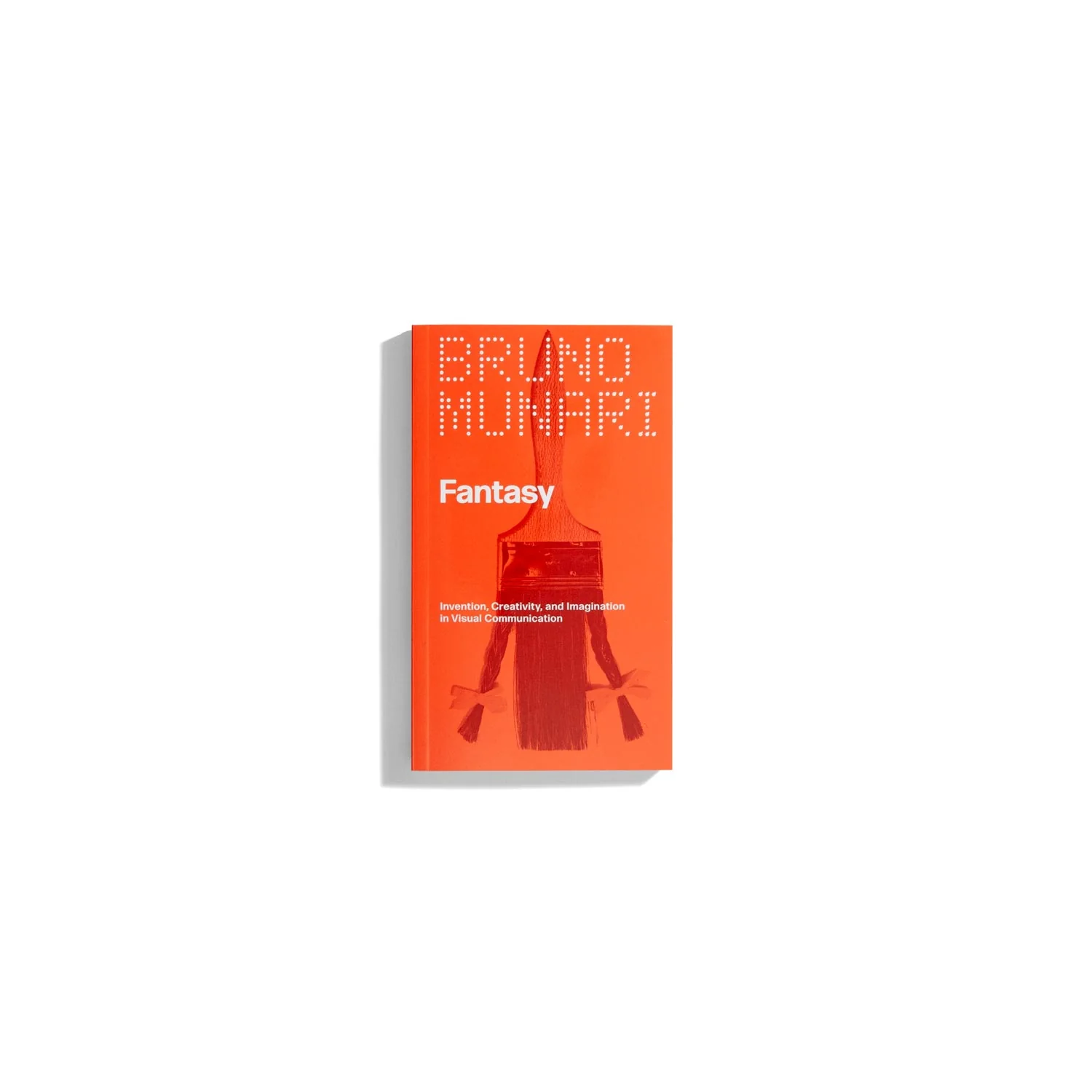
Fantasy - Bruno Munari
“But isn’t imagination also fantasy? And can’t fantastic images also assume the form of sounds? Musicians speak of sonic images, sound objects. How does one invent a fish tale, an air-cooled engine, a new plastic?… fantasy, invention, creativity think; imagination sees.”
—Bruno Munari
Never-before translated into English, Bruno Munari’s Fantasy (Fantasia, 1977), invites the reader to explore their own imagination, creativity, and fantasy through a journey in Munari’s mind and work experience. His theory of creativity, developed in conversation with the Reggio Emilia approach and the work of Jean Piaget, foregrounds the book’s journey through Munari’s own design processes, and his work for clients and with children.
By turning life and work into a classroom, Munari unlocks a path through imagination in order to access his, and in turn our, deepest sense of play. The facsimile reprint is accompanied by new contextual annotations by Munari scholar and design historian Jeffrey Schnapp. These micro-interventions highlight the innovations that make this work as relevant today as when originally published.
Original: $32.38
-65%$32.38
$11.33Produktinformationen
Produktinformationen
Versand & Rückgabe
Versand & Rückgabe
Description
“But isn’t imagination also fantasy? And can’t fantastic images also assume the form of sounds? Musicians speak of sonic images, sound objects. How does one invent a fish tale, an air-cooled engine, a new plastic?… fantasy, invention, creativity think; imagination sees.”
—Bruno Munari
Never-before translated into English, Bruno Munari’s Fantasy (Fantasia, 1977), invites the reader to explore their own imagination, creativity, and fantasy through a journey in Munari’s mind and work experience. His theory of creativity, developed in conversation with the Reggio Emilia approach and the work of Jean Piaget, foregrounds the book’s journey through Munari’s own design processes, and his work for clients and with children.
By turning life and work into a classroom, Munari unlocks a path through imagination in order to access his, and in turn our, deepest sense of play. The facsimile reprint is accompanied by new contextual annotations by Munari scholar and design historian Jeffrey Schnapp. These micro-interventions highlight the innovations that make this work as relevant today as when originally published.