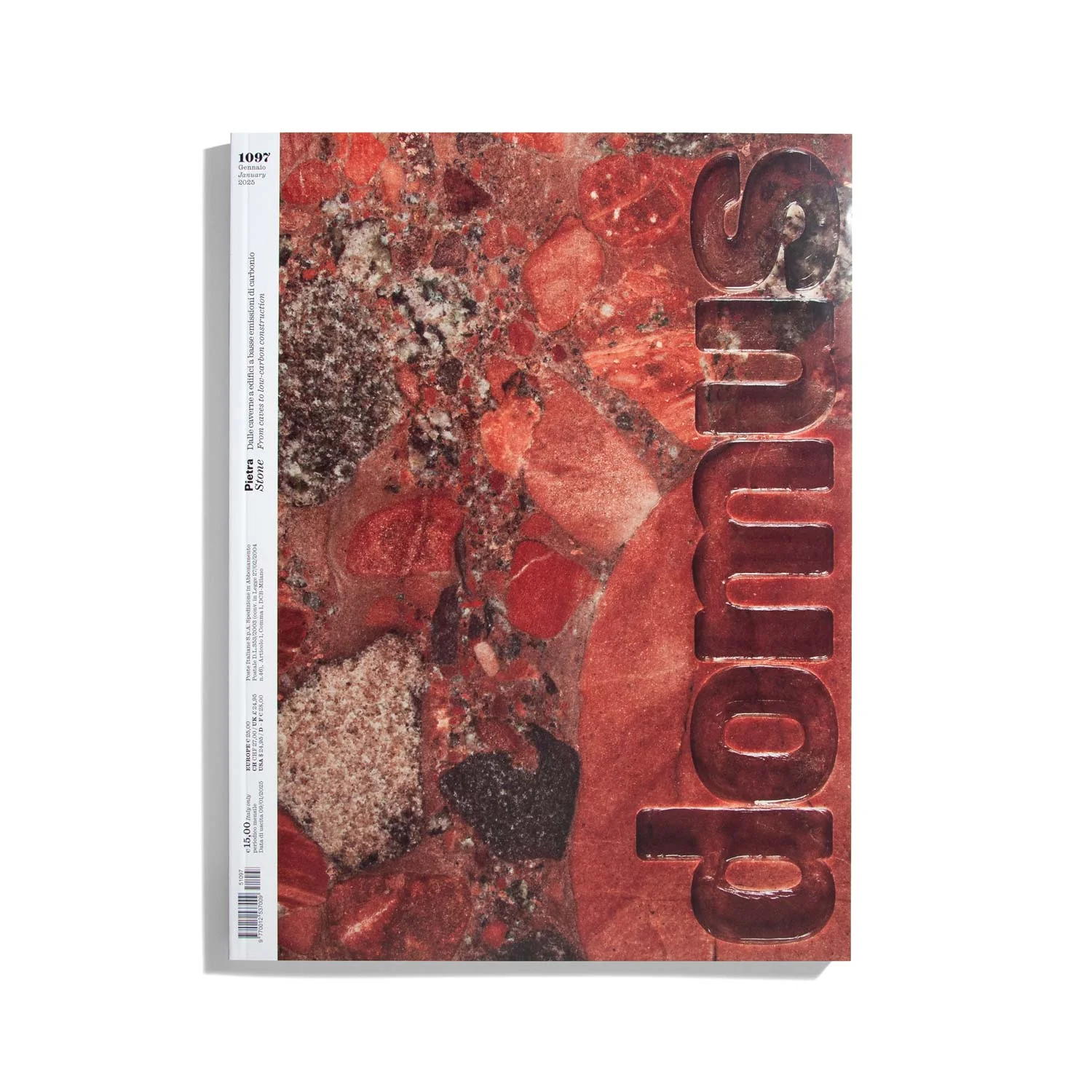
DOMUS #1097 2025
Welcome 2025. Domus greets the year with Bjarke Ingels, the new Guest Editor who inaugurates his scientific direction with “In Praise of Materialism”, that is, with “the search for ways in which human history has been shaped by the materials we have been able to gather and manipulate to shape the world around us”, writes Ingels in his first editorial on Domus.
An article that gives a precise direction and invites readers to a true virtuosity, a quantum leap from our cyberspace to material reality, where stone is the cradle of architecture and therefore of society and its relationship with life and the cosmos, from the Greek temple – “a wooden building translated into stone” to Göbekli Tepe, Stonehenge, the great pyramids, the Acropolis, Petra, the Colosseum, Angkor Wat, Machu Picchu up to the Arc de Triomphe and the Washington Monument, all rigorously in stone. The reason is simple, explains Ingels, because “before learning to cut and overlap stones, we lived in caves”.
Original: $32.97
-65%$32.97
$11.54Produktinformationen
Produktinformationen
Versand & Rückgabe
Versand & Rückgabe
Description
Welcome 2025. Domus greets the year with Bjarke Ingels, the new Guest Editor who inaugurates his scientific direction with “In Praise of Materialism”, that is, with “the search for ways in which human history has been shaped by the materials we have been able to gather and manipulate to shape the world around us”, writes Ingels in his first editorial on Domus.
An article that gives a precise direction and invites readers to a true virtuosity, a quantum leap from our cyberspace to material reality, where stone is the cradle of architecture and therefore of society and its relationship with life and the cosmos, from the Greek temple – “a wooden building translated into stone” to Göbekli Tepe, Stonehenge, the great pyramids, the Acropolis, Petra, the Colosseum, Angkor Wat, Machu Picchu up to the Arc de Triomphe and the Washington Monument, all rigorously in stone. The reason is simple, explains Ingels, because “before learning to cut and overlap stones, we lived in caves”.