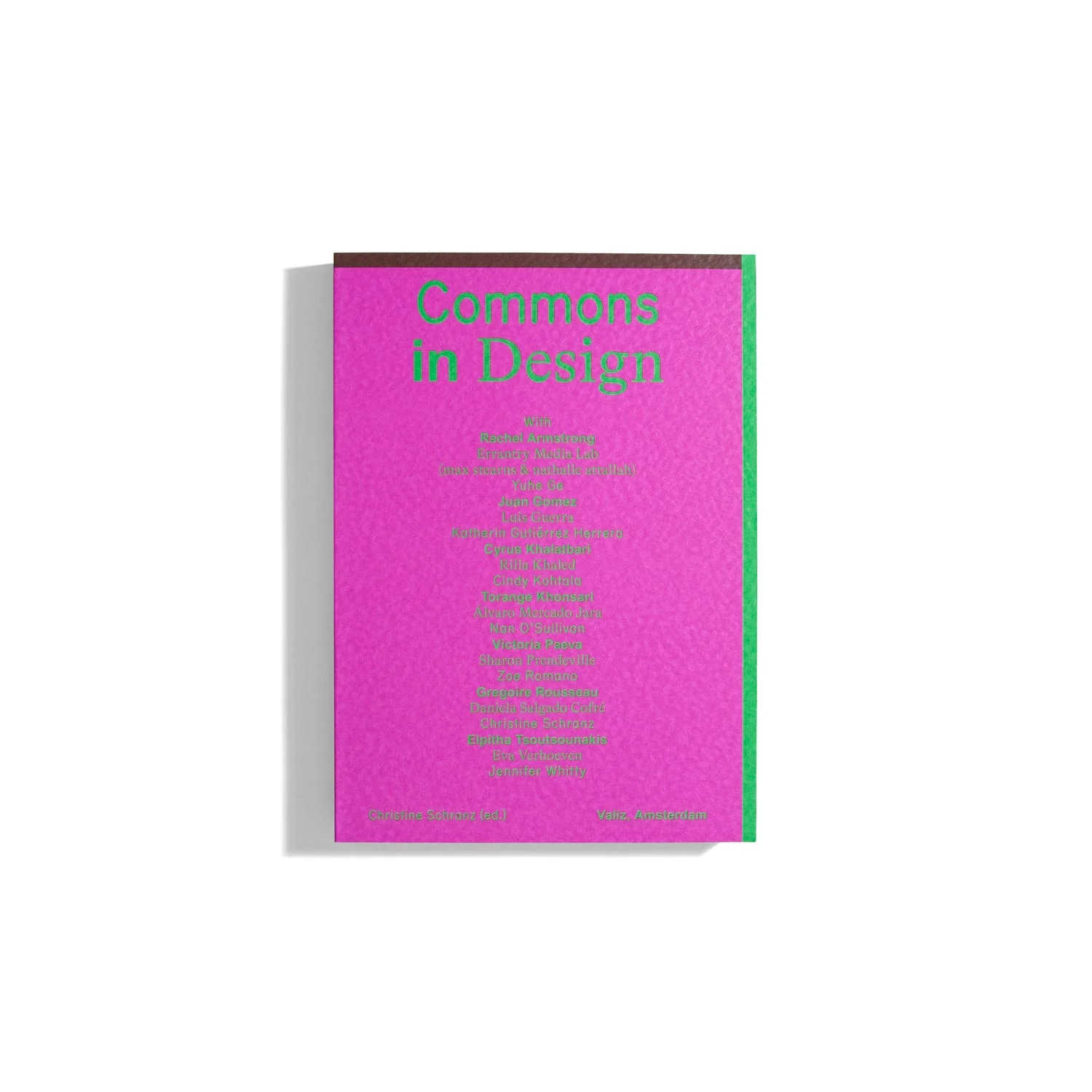
Commons in Design - Christine Schranz (ed.)
The scarcity of resources, climate change, and the digitalization of everyday life are fuelling the economy of swapping, sharing, and lending—all of which are in some way linked to a culture of commoning. In this context, we understand commons as community-based processes that use, collectively manage, and organize generally accessible resources—referring to both goods and knowledge. Commons in Design explores the meaning and impact of commons—especially knowledge-based peer commons—and acts of commoning in design. It discusses networked, participatory, and open procedures based on the commons and commoning, testing models that negotiate the use of commons within design processes. In doing so, it critically engages with questions regarding designers’ positionings, everyday practices, self-understandings, ways of working, and approaches to education. The book is divided into three parts: Part 1 – Design, Identities, and Working Environment; Part 2 – Design, Body, and Ecology; Part 3 – Design, Networks, and Digital Making.
Original: $36.50
-65%$36.50
$12.77Produktinformationen
Produktinformationen
Versand & Rückgabe
Versand & Rückgabe
Description
The scarcity of resources, climate change, and the digitalization of everyday life are fuelling the economy of swapping, sharing, and lending—all of which are in some way linked to a culture of commoning. In this context, we understand commons as community-based processes that use, collectively manage, and organize generally accessible resources—referring to both goods and knowledge. Commons in Design explores the meaning and impact of commons—especially knowledge-based peer commons—and acts of commoning in design. It discusses networked, participatory, and open procedures based on the commons and commoning, testing models that negotiate the use of commons within design processes. In doing so, it critically engages with questions regarding designers’ positionings, everyday practices, self-understandings, ways of working, and approaches to education. The book is divided into three parts: Part 1 – Design, Identities, and Working Environment; Part 2 – Design, Body, and Ecology; Part 3 – Design, Networks, and Digital Making.