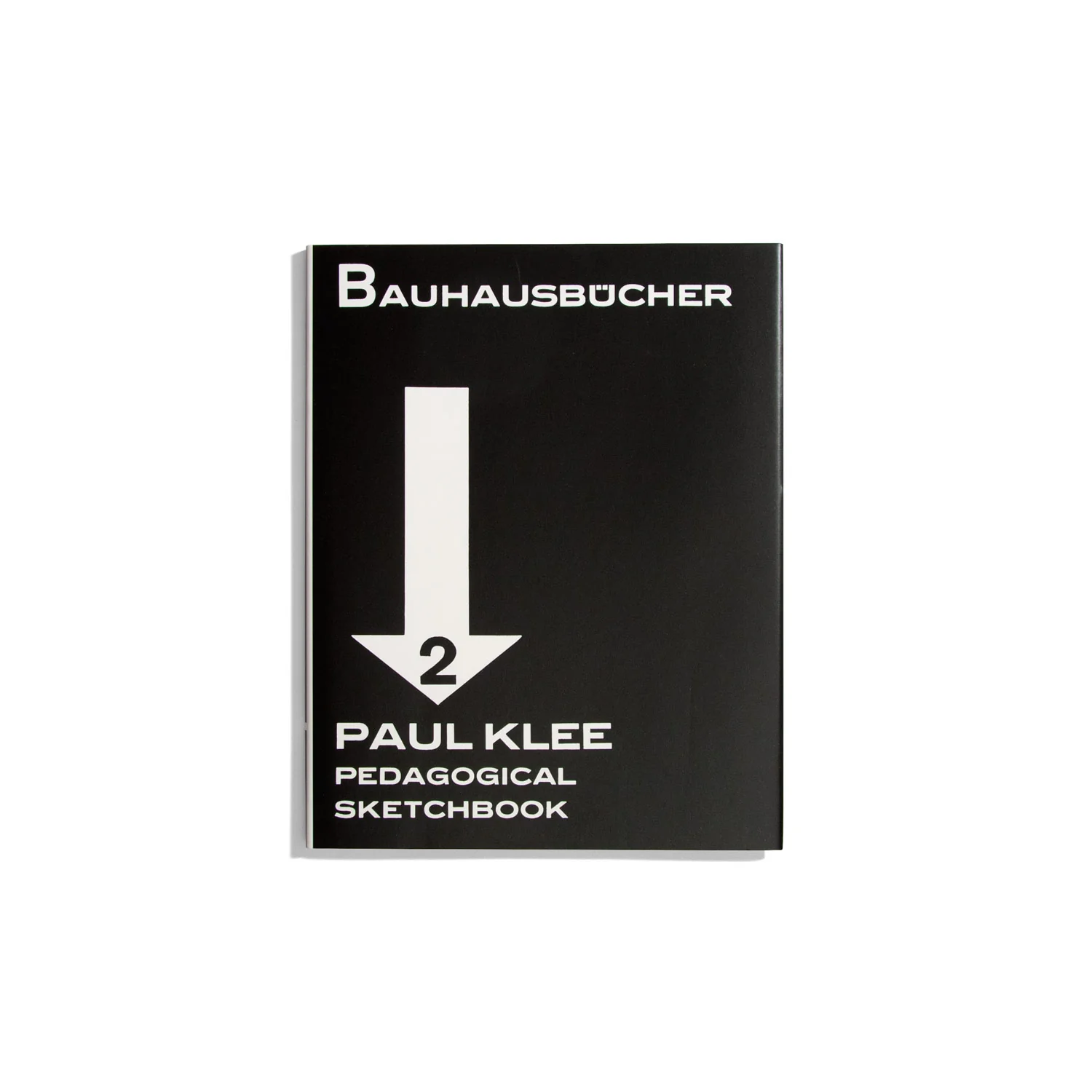
Bauhausbücher 2
Active at the Bauhaus between 1920 and 1931, teaching in the bookbinding, stained glass and mural-painting workshops, Paul Klee (1879-1940) brought his expressive blend of color and line to the school- and, with the second volume in the Bauhausbücher series, beyond its walls. moreIn his legendary Pedagogical Sketchbook, Paul Klee takes a theoretical approach to drawing using geometric shapes and lines. Evincing a desire to reunite artistic design and craft, and written in a tone that oscillates between the seeming objectivity of the diagram, the rhetoric of science and mathematics, and an abstract, quasi-mystical intuition, Klee's text expresses key aspects of the Bauhaus' pedagogy and guiding philosophies. And while Klee's method is deeply personal, in the context of the fundamentally multivocal Bauhaus, his individual approach to abstract form is typical in its idiosyncrasy. In this book, he presents his own theory about the relationships between line, shape, surface, and color in the visual space.
Produktinformationen
Produktinformationen
Versand & Rückgabe
Versand & Rückgabe
Description
Active at the Bauhaus between 1920 and 1931, teaching in the bookbinding, stained glass and mural-painting workshops, Paul Klee (1879-1940) brought his expressive blend of color and line to the school- and, with the second volume in the Bauhausbücher series, beyond its walls. moreIn his legendary Pedagogical Sketchbook, Paul Klee takes a theoretical approach to drawing using geometric shapes and lines. Evincing a desire to reunite artistic design and craft, and written in a tone that oscillates between the seeming objectivity of the diagram, the rhetoric of science and mathematics, and an abstract, quasi-mystical intuition, Klee's text expresses key aspects of the Bauhaus' pedagogy and guiding philosophies. And while Klee's method is deeply personal, in the context of the fundamentally multivocal Bauhaus, his individual approach to abstract form is typical in its idiosyncrasy. In this book, he presents his own theory about the relationships between line, shape, surface, and color in the visual space.