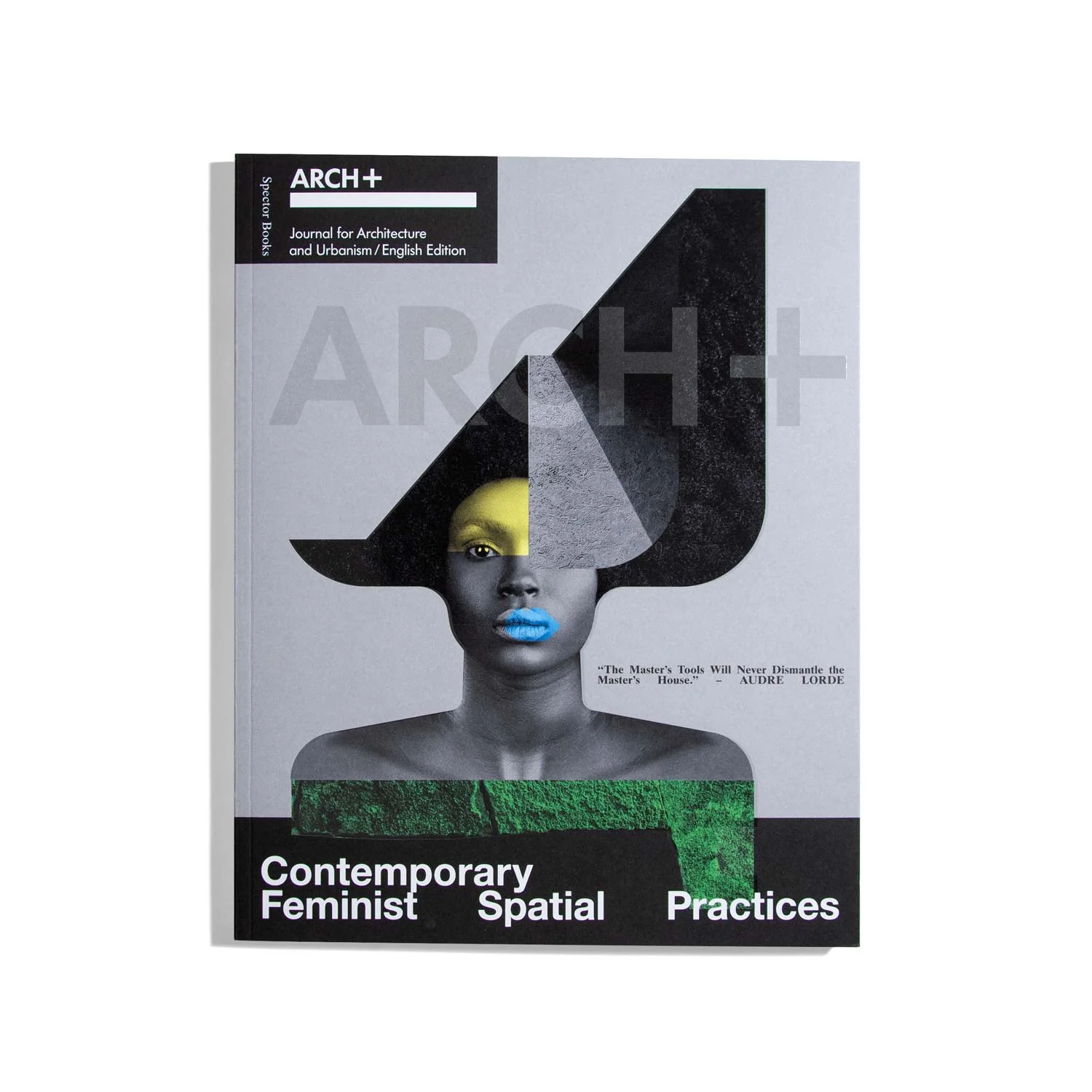
Arch+ 2023 - Contemporary Feminist Spatial Practices - English Edition
Freedom. Hardly any other word is invoked more frequently in recent social debates, for example on racism, gender, ecology or the Covid 19 pandemic. Curiously, it has mutated into a fighting term of that part of society that wants to preserve the status quo by all means. “Surely one can still say that!” is the mantra with which racist, anti-feminist or homophobic people, “lateral thinkers”, corona or climate deniers lament their supposedly threatened freedom of expression. These discussions often focus on a concept of freedom related to sovereignty, autonomy and consumption. But one’s own freedom cannot be considered separately from social, economic, infrastructural and natural dependencies – the pandemic and its consequences remind us of this, as do the consequences of global warming. “We are always in the middle of it.” This is how feminist science theorist Donna Haraway put it in 1995 in relation to the subjective interconnectedness of all knowledge, in which there is no independent outside, and argues for an “embodied and responsible objectivity”. This insight is also the basis of this issue. We ask how forms of social injustice are intertwined on different spatial levels. How can architecture, a discipline still strongly marked by patriarchal power hierarchies and relations of exploitation, redeem a new promise of freedom that is based on a transformative idea of justice?
Produktinformationen
Produktinformationen
Versand & Rückgabe
Versand & Rückgabe
Description
Freedom. Hardly any other word is invoked more frequently in recent social debates, for example on racism, gender, ecology or the Covid 19 pandemic. Curiously, it has mutated into a fighting term of that part of society that wants to preserve the status quo by all means. “Surely one can still say that!” is the mantra with which racist, anti-feminist or homophobic people, “lateral thinkers”, corona or climate deniers lament their supposedly threatened freedom of expression. These discussions often focus on a concept of freedom related to sovereignty, autonomy and consumption. But one’s own freedom cannot be considered separately from social, economic, infrastructural and natural dependencies – the pandemic and its consequences remind us of this, as do the consequences of global warming. “We are always in the middle of it.” This is how feminist science theorist Donna Haraway put it in 1995 in relation to the subjective interconnectedness of all knowledge, in which there is no independent outside, and argues for an “embodied and responsible objectivity”. This insight is also the basis of this issue. We ask how forms of social injustice are intertwined on different spatial levels. How can architecture, a discipline still strongly marked by patriarchal power hierarchies and relations of exploitation, redeem a new promise of freedom that is based on a transformative idea of justice?